What is Agent Sentinel?
AI agents are starting to do real work in banks and fintechs: reconciling payments, checking customer identities, drafting regulatory reports. They call AI models, use internal tools and send data over the network, often without a person watching each step.
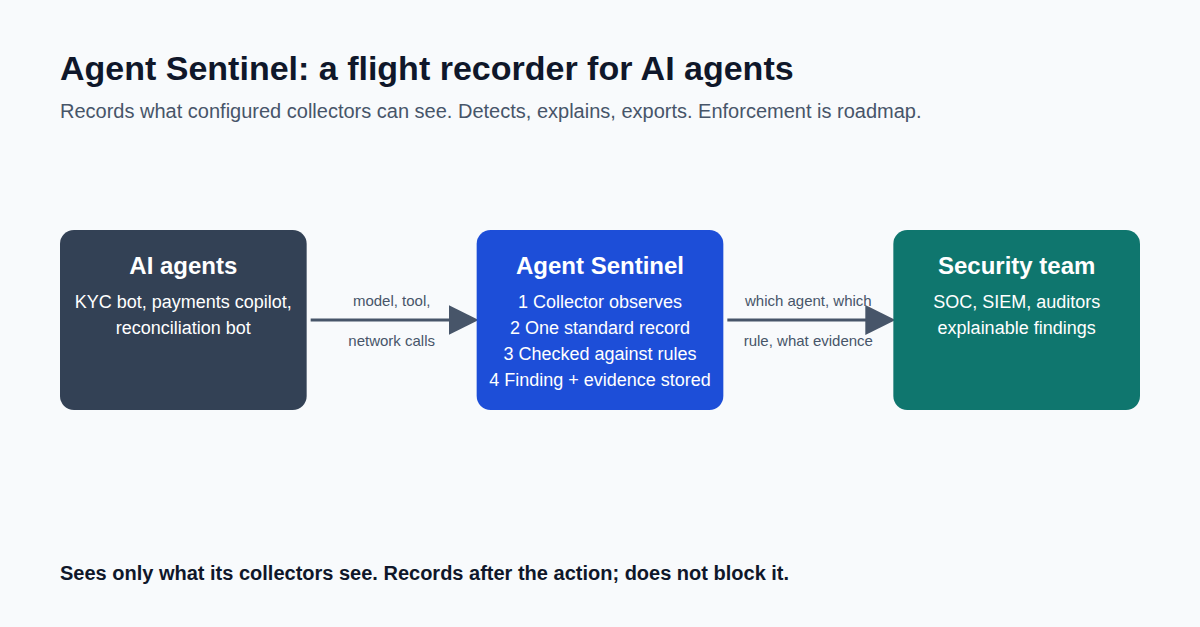
Agent Sentinel is a flight recorder for those agents. It records what each agent did, checks it against rules you wrote, and turns anything outside those rules into a plain-language finding your security team and auditors can read.
It records the actions its collectors can observe. Whether that record is trustworthy also depends on identity, collector coverage and how the evidence is stored and protected.
The use case
The following is an illustrative scenario, not a production incident.
A payments-reconciliation agent runs every night. Its job is to read the ledger, ask an approved AI model to summarise discrepancies, and email a report to finance. Nothing else.
One night it does something different:
- It reads the ledger. Allowed.
- It asks the approved model for a summary. Allowed.
- It sends a 250KB file to a server that isn’t on its approved list. Not allowed.
Agent Sentinel records all three steps as one timeline for that agent, and raises a finding for step 3: which agent, where the data went, which rule it broke, when, and which regulatory control that relates to. The finding can be exported to the security team’s existing SIEM.
Today it records and flags the transfer after it happens. Stopping it before it happens is on the roadmap.
The business problem it solves
Ask most firms what their AI agents did last month, and whether they can prove it was safe, and the honest answer is “not really”:
- Scattered logs alone don’t provide a complete audit trail. Properly designed logs can be evidence, but connecting the agent, its session, the action and the applicable policy often takes extra work.
- The trail is scattered. Model calls, tool use and network traffic sit in different systems, owned by different teams.
- Auditors need readable answers. “The model scored it 0.87” can’t be checked or challenged. “It broke rule X, here is the evidence” can.
- Regulators are asking. In a regulated firm, “we think it was fine” is not an answer to a question about an automated system.
That isn’t a technical gap. It’s a business risk, in the same category as not knowing who has access to your production database.
In one line: Agent Sentinel turns what your AI agents did into evidence you can show an auditor.
What it doesn’t do (yet): it only sees what its collectors are set up to see, and it records and flags rather than blocks.
A finding from the detection engine
A local check of the implementation used a synthetic event: agent
recon-bot, session demo-run, a POST to attacker-exfil.example, and
250,000 outbound bytes. The test policy allowed only ledger.internal and
set a 100,000-byte per-call limit. Running the published detection engine on
13 October 2026 produced two HIGH findings:
net.host_not_allowed: the destination was outsideallowed_hosts.net.oversize_egress: 250,000 bytes exceededmax_bytes_out_per_call=100000.
Both findings referenced the triggering event ID and included the violated policy clause. This is a reproducible demonstration of policy evaluation on a normalized event, not proof that a live collector captured a transfer or that data was actually stolen.
The detection engine implements these checks; the pipeline tests also exercise disallowed destinations and oversized payloads.
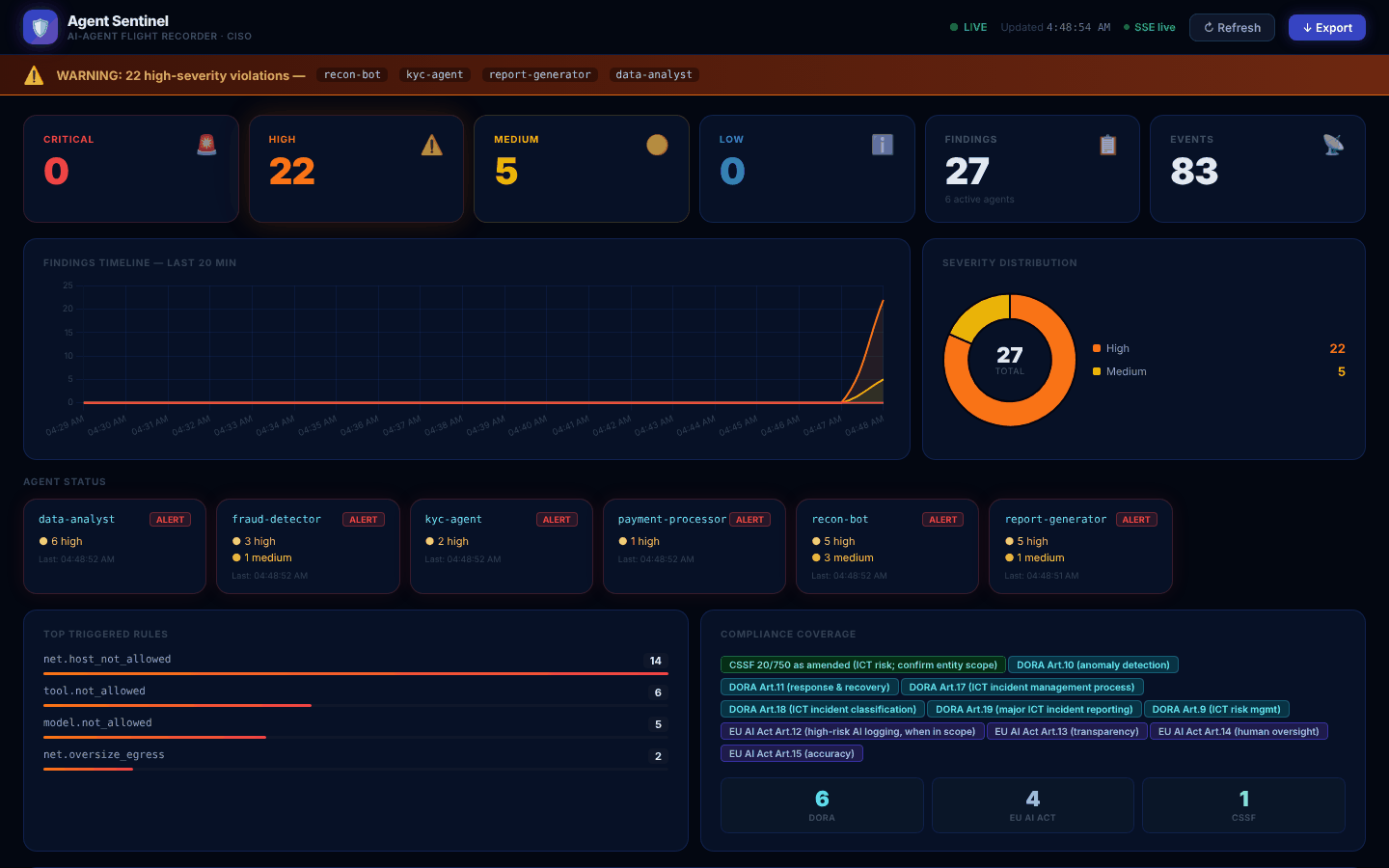
The same three steps were then sent to a running Sentinel server (fintech
policy, in-memory store, development mode) through its /ingest API,
alongside a few seconds of simulated traffic from the six demo fintech agents. Steps 1
and 2 produced no findings. Step 3 produced the same two HIGH findings, and
the dashboard showed them as they arrived:
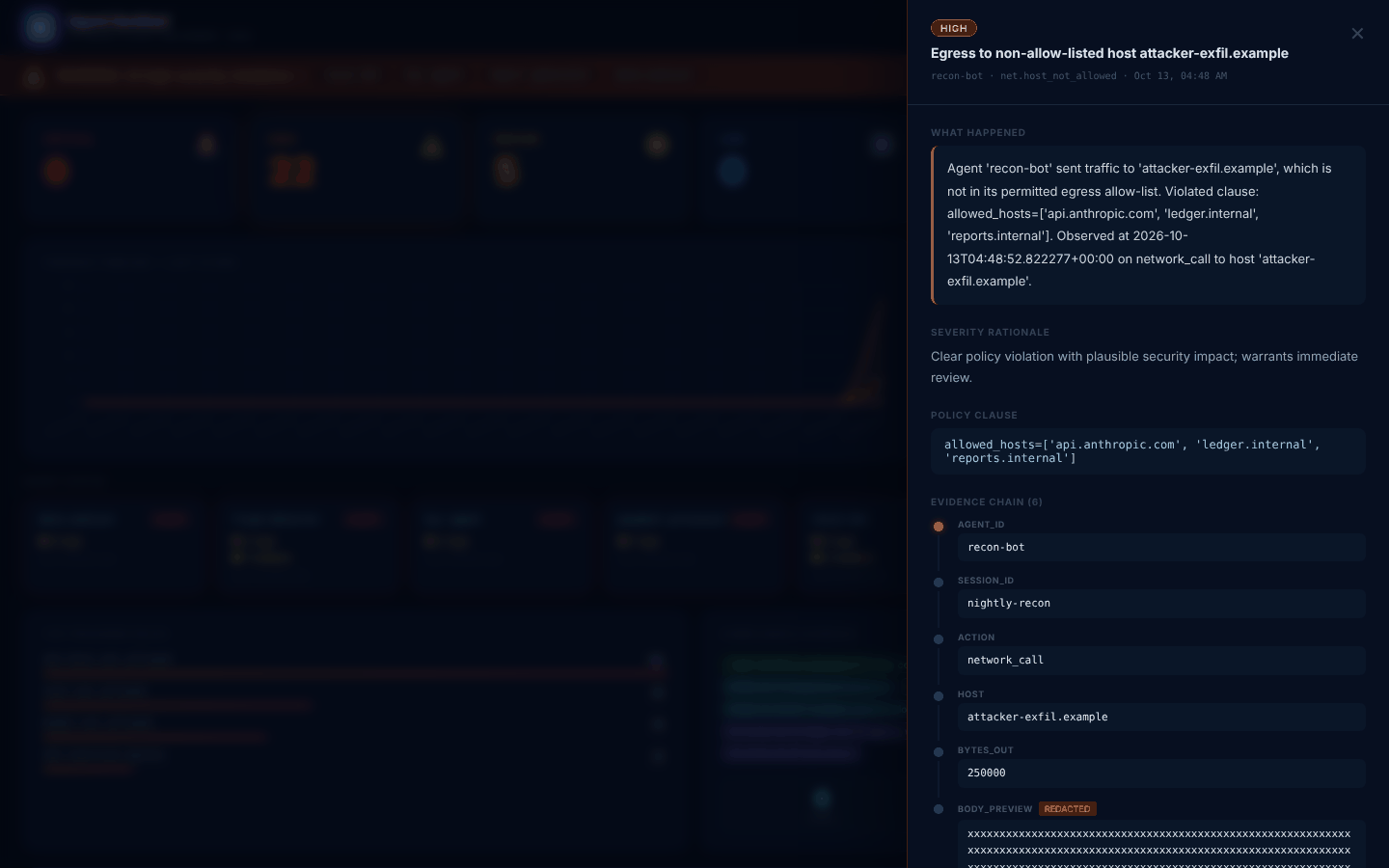
Opening the net.host_not_allowed finding for recon-bot shows the evidence
a reviewer works from: what happened in plain language, the violated policy
clause, and the evidence chain (agent, session, action, host, 250,000 bytes
out, and a redacted body preview):
The screenshots come from a local run on 13 October 2026, the same day the
end-to-end check (scripts/e2e.py --browser) passed against this code. The
traffic was sent straight to the API; no live collector captured it.
What makes the record trustworthy?
The event and finding schema keeps the agent ID, session ID, timestamp and event ID together. A finding carries its rule ID, policy clause, triggering event IDs and evidence fragments. That makes the explanation traceable: a reviewer can follow the finding back to the recorded action instead of accepting a risk score on faith.
There is a separate integrity mechanism for the API audit log. The hash-chain implementation links each audit entry to its predecessor, and the PostgreSQL backend serializes updates to the chain head. Verification can detect edited entries and broken links.
That protection has a boundary: the hash chain covers the API audit log, not every agent event or finding. Someone able to rewrite the database and recompute the chain could still alter it consistently. Stronger assurance requires anchoring the chain head outside that database, protecting access and retention, and validating agent identity at collection. A complete-looking timeline is not proof that collectors saw everything.
Regulatory control references help reviewers navigate from a finding to a relevant control. They support an audit; they do not, by themselves, demonstrate compliance. Applicability, implementation, operating evidence and review still need to be assessed.
What this adds to monitoring and SIEM
Monitoring tells you about requests, errors and latency. A SIEM can correlate security events and apply detection rules, including agent-specific rules if you build them. Agent Sentinel packages that agent-specific work: a common event shape for model, tool and network activity; a declared policy for each agent; and findings that link the observed action to the rule and evidence.
The intended handoff is a finding your SOC can investigate in its existing SIEM. The value is the agent context and policy-to-evidence link, not an assertion that existing monitoring tools cannot do this. Its usefulness depends on how much of that work your organization already has in place.
The trade-off behind rules first
The project’s first architecture decision records the choice between ML-first anomaly detection and explicit policy checks. I chose rules first because I wanted the answer to “why did this fire?” to be a clause an engineer could inspect and change in a pull request.
The cost is maintaining a policy for each agent, and missing behavior that those rules do not describe. Statistical signals add context, but an unusual action is not automatically a policy violation. For this payments example, checking the destination and payload limit gives a more defensible explanation than asking a model to decide whether the transfer looks suspicious.
Recording before enforcing is another deliberate boundary. Today, a finding can help investigate a transfer after it happens; it cannot recover the data or stop the transfer. Pre-action blocking remains a separate engineering step.
What’s in this series
A few short parts, each one design decision and why it was made:
- Why AI agents need a flight recorder: this part.
- From Simulated Traffic to Real Model Calls: record first, block later, and why recording must never break the agent.
- Rules First, Statistics Second: why a readable rulebook comes before any AI model.
- The Enterprise Foundation: identity, audit trail and human approvals.
- Feeding the SOC, and What’s Next: evidence for your existing SIEM, not another dashboard.
For architects and engineers: the design, diagrams, and links into the code and tests are in the technical deep dive on GitHub.